
The core argument:
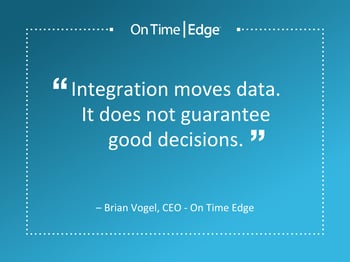
- Integration moves data.
- It does not guarantee good decisions.
- Scheduling is the control layer where digital strategy becomes accountable.
- In complex operations, 2-5% of revenue is often lost to execution gaps.
- This is an operating model problem, not a missing-tool problem.
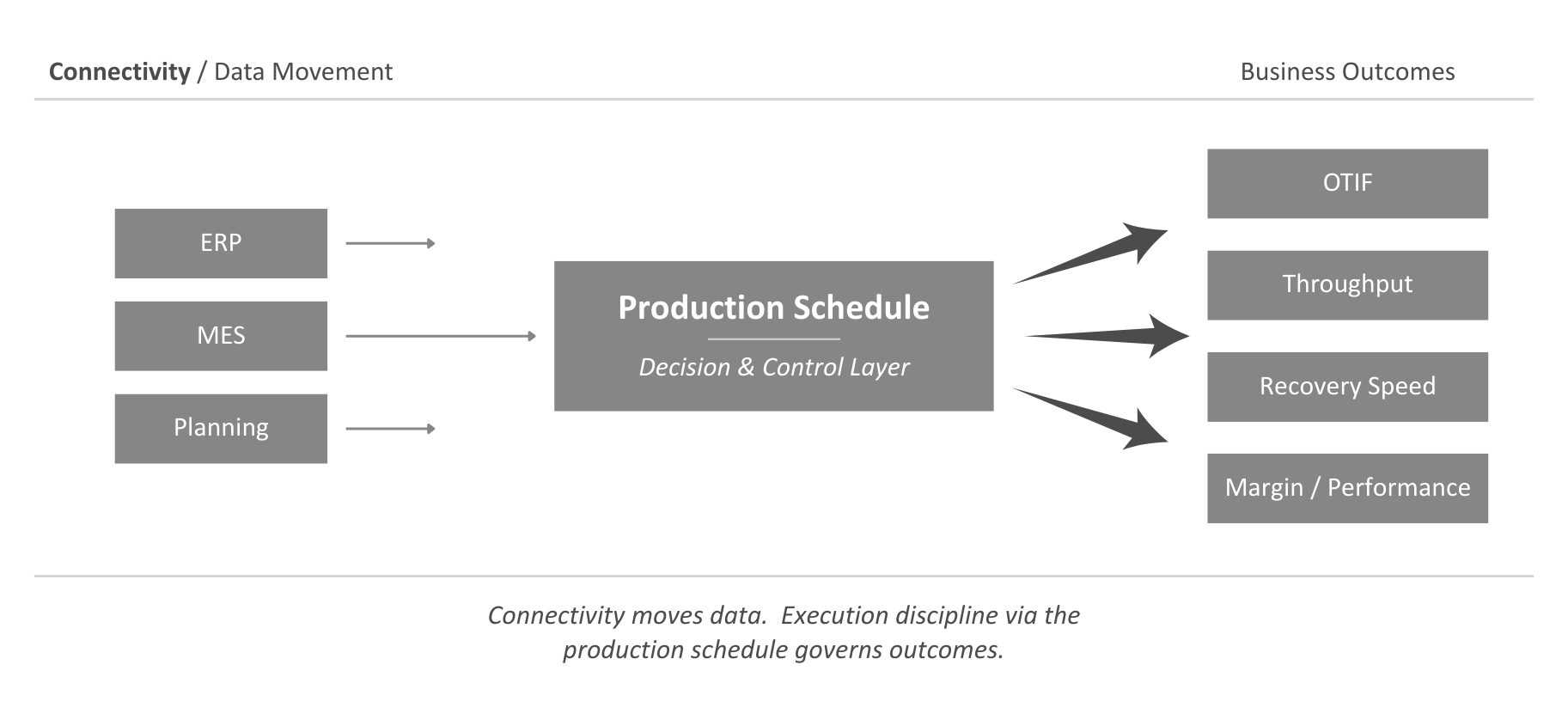
Most leadership teams have done the hard work: ERP is integrated, MES is connected, demand planning is aligned. Data moves. On paper, the digital foundation is solid.
And yet performance still leaks: OTIF is inconsistent. Expedites persist. Changeovers eat capacity. Margins feel tighter than they should.
Across manufacturing, we repeatedly see 2-5% of revenue quietly lost to execution gaps. Not because systems aren’t connected, but because decision quality between planning and execution isn’t disciplined.
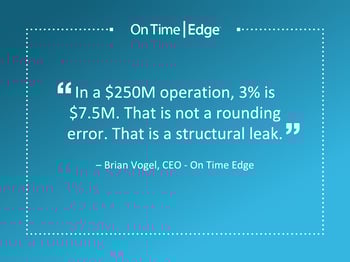
Here’s what we see for a ~$300M manufacturing company:
- $2-3M in expediting and premium freight
- $3-5M in lost constrained throughput
- $2-4M in avoidable changeover and labor inefficiency
The exact mix varies by business, but even before secondary effects, this usually adds up to roughly 2-4% of revenue.
This pattern shows up most clearly in complex manufacturing environments—multi-line, high-mix, regulated, or constraint-heavy operations—where sequencing, changeovers, labor, and quality constraints interact every day.
Why Connected Factories Still Miss Targets
More data creates the opportunity to improve decisions.
It does not automatically improve them.
The execution gap is the space between what your systems know and what your production schedule can actually achieve under real-world variability: labor availability, sequence-dependent changeovers, QA holds, material delays, and bottlenecks that move.
This is why many complex operations still rely on spreadsheets at the point of scheduling. Not because teams are careless—because spreadsheets feel controllable. But spreadsheets fracture a connected architecture.
They cannot:
- Enforce sequence-dependent changeovers
- Model labor and secondary constraints reliably
- Absorb variability by product, not averages
- Expose tradeoffs when expedites displace profitable orders
In practice, that means your enterprise stack executes whatever schedule it’s given—good or bad—very efficiently.
What “Execution-Ready” Looks Like in Practice
At one beverage bottling operation we’re familiar with, constrained packaging lines were limiting growth. Leadership believed they were capacity-bound. ERP, demand planning, and shop-floor systems were already connected.
Before:
- Schedule adherence was inconsistent, with daily replanning the norm.
- Changeovers were sequenced locally, not across the full constraint set.
- Constrained line utilization hovered in the low-to-mid 80% range.
- Expedites and short-notice schedule changes were routine.
After introducing constraint-aware, execution-ready scheduling:
- Constrained line utilization increased by roughly 10-15% without adding assets or headcount.
- Total changeover time was reduced by approximately 20% through better sequencing.
- Schedule stability improved materially, with far fewer same-day replans.
- Throughput increased, and leadership no longer viewed the operation as capacity-bound.
The systems were already integrated. The improvement came from disciplining the decisions embedded in the schedule, not from adding more connectivity.
This didn’t come from a new report or a parameter tweak—it required tightening data discipline, clarifying decision ownership, and changing how schedules were built and used day to day.
Where the 2-5% Disappears
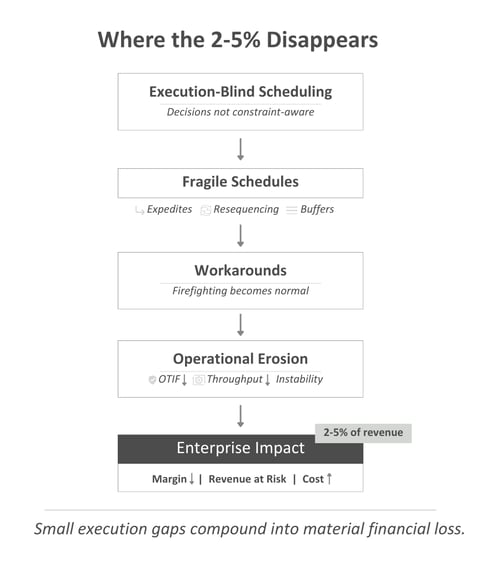
Performance leakage rarely shows up as a single catastrophic failure. It compounds through small, repeated inefficiencies:
- Changeovers sequenced poorly
- Labor assumed available when it isn’t
- QA holds modeled as averages instead of by product
- Expedites destabilizing downstream flow
- Planners compensating manually without visibility into tradeoffs
Each issue looks manageable in isolation. Together, they quietly erode service, throughput, and margin.
Why Integration Doesn’t Create Execution Readiness
Most organizations believe integration equals readiness.
It doesn’t.
- ERP is excellent at transactions and planning logic.
- MES executes what it is given.
- Forecasting aligns supply and demand at a macro level.
But there is a critical layer in between: production scheduling as an execution discipline.
An MES will execute an inefficient schedule just as faithfully as a disciplined one. If the schedule cannot survive labor variability, downtime, or material delays, your digital stack simply executes the inefficiencies faster.
Leadership often responds by tightening ERP parameters or adding more reporting. Far less often do they ask the harder question: “Is our schedule built on explicit, constraint-aware decision logic that holds under pressure?”
Connectivity moves data. Execution discipline governs outcomes.
From Connectivity to Control: How the Schedule Creates Execution Readiness
The problem is not a missing tool. It is a missing execution discipline.
Execution-ready scheduling is not about prettier Gantt charts or adding another layer of software. It is about making the schedule the place where decisions, constraints, and accountability come together.
In practice, that means:
- Real constraints are explicitly modeled (equipment, labor, setups, cleanouts, materials)
- Tradeoffs are evaluated before commitments are made
- Decision rights and escalation paths are clear when conditions change
Recovery should be measured in hours, not days. And schedule adherence should be a first-class operational KPI.
That’s why planning and scheduling software alone is necessary, but not sufficient.
PlanetTogether provides the constraint-based scheduling engine that makes tradeoffs visible and plans executable under real-world conditions. On Time Edge ensures that this capability is designed into the operating model—architecture, data trust, decision rights, and execution rhythms—so scheduling becomes a control layer the business actually runs on, not just another planning output.
The goal is not more tools.
The goal is accountable execution.
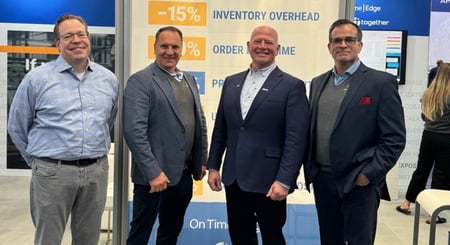
At Hannover Messe, we’ll be going deeper into these questions in executive sessions and panel discussions—why connected factories still miss throughput and delivery targets, what it really takes to make schedules hold under real-world variability, and how data trust and decision governance determine execution performance. Those sessions are designed to share the frameworks and patterns we see across leading manufacturers.
The executive diagnostic is the fastest way to apply those same ideas directly to your operation and see where performance may be leaking today.
Get Clarity in 15-30 Minutes with an Executive Diagnostic at Hannover Messe
During Hannover Messe, we’re also holding a limited number of 15-30 minute executive diagnostics at our stand.
This is a private work session, not a product demo.
In a short, focused conversation, we will help you:
- Identify where scheduling and execution misalignment may be costing you performance and margin;
- Determine whether the “2-5% of revenue leakage” pattern applies to your operation; and
- Clarify whether there is a real, defensible business case to pursue—or not.
You’ll leave with a clearer picture of whether your current operating model is already optimized, or where execution discipline is breaking down between planning and the shop floor.
If you’ll be at Hannover Messe and want that clarity while you’re already there, we recommend reserving a slot in advance. Availability is limited.
Reserve an executive diagnostic at Hannover Messe; it’s an on-site, by-appointment working session for qualified operations, supply chain, and IT leaders.
This article is adapted from work originally published by PlanetTogether in collaboration with On Time Edge.
All trademarks, service marks, trade names, product names, and logos are the property of their respective owners.

Topics discussed

Related Posts

Subscribe to Our Blog
Get the latest best practices and insights sent directly to you. (We promise, no automated marketing messages.)