The Execution Gap: What Hannover Messe 2026 Confirmed
|
Event |
Hannover Messe 2026 — the world's largest industrial technology trade fair |
|
Core Shift |
From innovation to industrialization — from pilots to production, from knowing to doing |
|
What's New |
AI everywhere, digital twins advancing, CESMII i3-X gaining vendor momentum — but execution at scale still breaking down across every hall |
|
Biggest Gap |
The integration layer between APS, MES, and ERP has never been properly solved — scheduling produces the plan, but the floor cannot execute it |
|
Three Signals |
|
|
The Takeaway |
The next phase will not be defined by new technology — it will be defined by who can make the technology work together, at scale, without adding complexity |
I Walked Every Hall at Hannover Messe 2026. The Problem Has Not Changed.
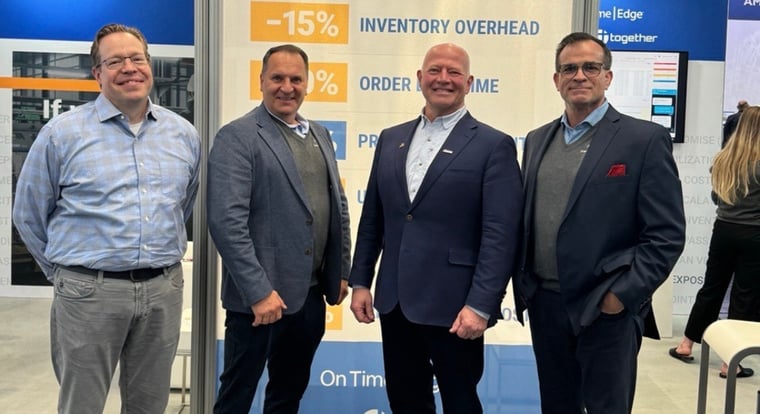
I just returned from Hannover Messe 2026. Four days, hundreds of conversations, dozens of demos across every major hall.
AI was everywhere. Data strategies were in place. Digital twins were advancing on every booth.
What I did not see: execution at scale working.
That gap — between the technology on display and the outcomes manufacturers are actually achieving — is not a technology problem. It is a model problem. And it is getting more expensive every quarter.
Everyone in manufacturing is testing new AI applications. Most of those pilots never reach production. Everyone has a proof of concept. Almost no one has operationalized it across planning, scheduling, and shop floor execution in a way that holds up under real operating conditions.
That is the story of 2026 in manufacturing. And it is where On Time Edge is positioned to do its most important work.
Watch: Brian Vogel and John Dyck — Breaking Down Data Silos with Industrial AI at Hannover Messe 2026
At Hannover Messe 2026, Brian sat down with CESMII CEO John Dyck to discuss what the show floor confirmed — and what the vendor adoption numbers behind CESMII i3-X reveal about where industrial interoperability is actually heading. John's data point alone is worth the watch: nearly 20 vendors have already demonstrated i3-X integration in a pre-launch environment, including AWS, Siemens, Rockwell, and GE.
Check out this clip from John Dyck, CEO, CESMII, and Brian Vogel, CEO, On Time Edge.
The Market Has Already Moved Past Awareness
Why is manufacturing execution failing at scale in 2026?
Manufacturing execution is not failing because manufacturers lack data, technology, or investment. It is failing because the integration layer between planning systems, execution systems, and data infrastructure has never been properly solved.
Scheduling produces the plan. MES manages the floor. ERP holds the demand signal. But these systems do not talk to each other in real time, under real operating constraints, in a way that produces consistent outcomes. The result is manual reconciliation, delayed decisions, and a persistent gap between what was planned and what actually gets executed.
Every manufacturing leader I spoke with at Hannover Messe already knows their environment is fragmented. They already know their data is delayed. They already know their execution is inconsistent. We have spent years as an industry describing this. At this point, continuing to lead with the problem is not just ineffective — it is noise.
The question they are asking now is not "what is wrong?"
It is: "Who can actually fix this across my environment without creating more complexity?"
That shift matters. It changes what a compelling vendor conversation looks like. And it changes what the market will actually pay for.
Three Signals That Were Impossible to Miss
Walking the halls of Hannover Messe, three themes came through so consistently that I stopped treating them as observations and started treating them as data points.
Signal 1: AI Is No Longer the Headline. Execution Is.
Every company is exploring AI. Very few have operationalized it into scheduling, planning, and shop floor execution in a way that drives measurable results.
The manufacturers who are winning right now are not the ones with the most sophisticated AI models. They are the ones who have built the operational infrastructure beneath the AI — the connected planning, scheduling, and execution layer that makes AI outputs actionable on the shop floor. Without that foundation, AI use cases remain pilots rather than enterprise capabilities.
Signal 2: Interoperability Remains the Unmanaged Bottleneck
Everyone at Hannover Messe talked about connectivity. Almost no one has solved orchestration — the active management of data flows and decision handoffs across MES, APS, ERP, and data layers — in a way that holds up under real operating conditions.
What is the gap between APS and MES?
APS systems produce the optimized plan — what to make, when, on which resources, in what sequence. MES manages the shop floor — work orders, real-time tracking, operator instructions. When these two systems are not synchronized in real time, the scheduling engine cannot see the actual constraints shifting on the floor, and the floor cannot execute to the optimized pace of the schedule. Planners spend their day reconciling the gap manually instead of managing flow through the constraint. This broken handoff is not a software selection problem. It is an integration and constraint-management problem — and it is the true bottleneck of modern manufacturing.
Signal 3: Scheduling and Planning Are Becoming the Control Point
Scheduling and planning are no longer just operational functions. They are becoming the central control point of the manufacturing enterprise — where demand signals meet capacity constraints, where AI outputs become executable plans, and where performance is either realized or lost.
We see this in our own client work. JARP Industries — a high-mix, high-volume hydraulic cylinder manufacturer in Wisconsin — came to On Time Edge with exactly this problem. Scheduling was manual, constraints were unmanaged, and the gap between plan and floor was burning out their best people. Within weeks of deployment, JARP reduced order backlog by 35%, cut overtime by 35%, and grew weekly sales by 10% while holding labor headcount flat. The following year, they won a supplier-of-the-year award from a top-five customer — specifically for achieving perfect on-time delivery.
That result did not come from better software alone. It came from closing the handoff between plan and execution. If you cannot close that gap at the scheduling layer, you cannot close it anywhere downstream.
A Notable Step Forward: CESMII i3-X and the Interoperability Push
One of the more grounded efforts gaining traction at Hannover Messe was the CESMII i3-X Framework — a structured attempt to establish common interoperability standards across industrial systems, with goals that include reusable data building blocks, reduced one-off integrations, and portability across environments. The direction is right. This is exactly where the industry needs to go.
But frameworks create the foundation. They do not operationalize the outcome. Even with i3-X fully adopted, manufacturers still need to map their current state, align IT and OT stakeholders, integrate across legacy and modern platforms, activate scheduling and execution workflows, and scale with governance. That gap between framework and outcome is where most organizations stall — and where execution models, not standards, determine who actually crosses it.
What "Execution at Scale" Actually Requires
How do manufacturers improve schedule adherence?
Schedule adherence improves when three conditions are met simultaneously: APS outputs are actively synchronized with MES execution in real time, constraints are managed proactively rather than reactively, and planners are freed from manual reconciliation, allowing them to focus on exception management.
Here is what that looks like when we deploy it at On Time Edge:
We align APS outputs with MES execution. Not theoretically — through active, governed data flows that ensure the schedule reflects what is actually happening on the floor, in real time.
We synchronize constraints as they change. Machine availability, material delays, operator capacity — these are not static inputs. A plan that does not update as constraints shift is wrong by the time it reaches the floor.
We eliminate manual reconciliation loops. Every hour a planner spends reconciling system discrepancies is a signal the execution layer is broken. Every manual touchpoint is a failure point.
We build for scale from day one. The deployment starts with a focused use case. But the architecture, governance, and data model are designed for replication across sites. A one-off engagement is not an execution model. It is a pilot.
JARP Industries applied this model and closed the gap between plan and floor within weeks — reducing backlog by 35%, cutting overtime by 35%, and growing sales 10% without adding headcount. That is what a closed execution loop looks like in practice.
The Operating Model That Actually Delivers
Execution only scales when the model is structured. At On Time Edge we use a four-phase engagement model that is consistent, repeatable, and governed across every client and every site.
Assess. We baseline the current state using real operating data — not surveys, not demos. Actual system outputs, schedule adherence history, constraint logs, and planner workflows. This produces a prioritized gap analysis with quantified opportunity before a single integration decision is made.
Align. We align stakeholders across IT and OT on a shared target state before a single line of integration work begins. Misaligned stakeholders are a more common cause of failed deployments than technical problems. We solve that before it becomes expensive.
Deploy. We activate the solution without disrupting operations. First measurable outcomes — schedule adherence improvements, deviation reductions, planner productivity gains — delivered in weeks, not months. We commit to that timeframe because we have built the model to deliver it.
Scale. We extend the deployment across sites using a standardized, governed architecture. Not a custom build at each location. A repeatable model that compounds. This is what separates an execution partner from a one-off implementation vendor.
Frameworks like i3-X can support this model. They provide structure we leverage. But they do not replace the model itself. The market does not need another voice explaining the problem. It needs a partner that can walk in, take ownership, and deliver. That is the bar now.
Why Most Manufacturing Vendors Are Missing the Moment
Most vendors at Hannover Messe are still marketing like the buyer is early in their journey. They lead with the problem — fragmentation, data silos, lack of interoperability — because that messaging worked three years ago.
The buyer is already past that. When a VP of Operations hears "we understand your challenges," what they actually hear is: you are describing what I already know. That does not signal capability. It does not build confidence. It does not move a decision forward.
On Time Edge operates differently. We are not tied to a single platform — we work across more than 15 scheduling and planning solutions. The requirement drives the solution, not the other way around. We connect and activate the systems already in your environment without requiring a rip-and-replace approach. And we take ownership of the outcome, not just the implementation.
The Language the Market Is Actually Buying
The language of the market has changed. Transformation language — digital transformation, operational excellence, Industry 4.0 — no longer moves decisions forward. Every vendor uses it. None of it differentiates.
Speak in outcomes or do not speak at all. The language that resonates now is:
- Throughput
- Schedule adherence
- Deviation reduction
- Cycle time
- Planner productivity
If you cannot tie what you sell to those specific metrics — with a defined timeframe and a clear delivery model — you are not in the conversation. The manufacturing leaders I spoke with at Hannover Messe are making buying decisions based on outcome commitments, not capability claims.
Where On Time Edge Is Positioned — And Why It Matters Now
The next phase of this industry will not be defined by new technology. It will be defined by who can make the technology work together. Quickly. At scale. Without adding complexity.
That is the bar. And it is the bar On Time Edge is built for. We are execution-led. Vendor-agnostic. Outcome-focused. And we take ownership of the result — across systems, functions, and sites.
If your organization is sitting on technology investments that have not translated into measurable shop floor outcomes, the problem is almost certainly not the technology. It is the model connecting the technology to the execution layer. That is a solvable problem. And it is exactly what we do. Schedule your Digital Strategy Assessment to get the conversation moving today.
Frequently Asked Questions
What is manufacturing execution at scale?
Manufacturing execution at scale means operating a consistent, governed production execution model across multiple sites, systems, and teams — where planning outputs reliably translate into shop floor actions, constraints are managed in real time, and performance metrics improve predictably. It requires connected APS, MES, and ERP systems operating under a shared data and governance model.
Why do most manufacturers struggle to scale beyond pilots?
Only 14 percent of enterprises have scaled AI or advanced operational systems to production grade, despite 78 percent running pilots. The primary blockers are integration complexity with legacy systems, absence of monitoring tooling, and unclear organizational ownership. The pilot works in a controlled environment; the production deployment fails because the underlying integration and governance model was never built for scale.
What is the gap between APS and MES?
APS systems optimize production plans based on demand signals, capacity constraints, and material availability. MES systems manage real-time shop floor execution — work orders, operator instructions, production tracking. The critical integration point between them — where optimized plans become actionable floor instructions and real-time floor data feeds back into scheduling — is where most execution breakdowns occur and where the greatest performance opportunity exists.
How long does it take to see results from a planning and scheduling integration?
With a structured deployment model — Assess, Align, Deploy, Scale — initial measurable improvements in schedule adherence, deviation reduction, and planner productivity are typically achievable within weeks of deployment activation. A focused use case with a clear outcome commitment should not require a multi-year transformation cycle.
What is the CESMII i3-X framework?
The CESMII i3-X Framework is an industrial interoperability standard developed by the Clean Energy Smart Manufacturing Innovation Institute. It is designed to normalize how data is structured and shared across manufacturing systems — creating reusable, composable data building blocks that reduce site-specific integration complexity and enable portability across environments. It represents a credible and necessary foundation for the industry. Translating that foundation into operational outcomes still requires a structured execution model on top of it.
Does On Time Edge replace existing manufacturing systems?
No. On Time Edge is a vendor-agnostic integrator. We connect and activate the systems already in your environment — MES, APS, ERP, data historians, and other operational platforms — without requiring a rip-and-replace approach. Our value is in making your existing technology investments work together effectively, at scale, with governance built in from day one.
Topics discussed

Related Posts


Subscribe to Our Blog
Get the latest best practices and insights sent directly to you. (We promise, no automated marketing messages.)