
For years, technical debt in manufacturing was treated as a background condition—uncomfortable, inconvenient, but tolerable. It lived in aging systems and brittle integrations that everyone knew were imperfect but “good enough.”
That’s no longer true.
Today, technical debt directly constrains the outcomes manufacturing executives are accountable for: on-time delivery, inventory performance, responsiveness to disruption, margins, quality, compliance, and the ability to integrate acquisitions. What was once accepted as a technical inconvenience now shows up as slower decisions, higher risk, missed commitments, and lost opportunity.
What many organizations experience as stalled digital transformation in manufacturing is not a lack of tools or ambition, but the accumulated drag of technical debt across systems, data, and execution.
The impact is already visible in day-to-day operations. Divisions, plants, and functions are being asked to operate with far greater speed and precision than their underlying architectures were designed to support. Shop-floor scheduling, real-time planning, advanced analytics, and AI-driven decision support all assume reliable, interoperable data—conditions many environments simply do not have. As a result, technical debt has moved into strategic conversations for operations leaders and senior executives. It is no longer just an IT concern; it is a structural constraint on operational and business performance.
What “Technical Debt” Really Means in Manufacturing
One reason technical debt is so difficult to address in manufacturing is that it rarely exists in a single place. It accumulates quietly over time across systems, processes, and data, often the result of perfectly rational short-term decisions.
In manufacturing environments, technical debt typically appears in five interrelated forms:
Integration debt emerges when systems are connected through brittle, point-to-point interfaces, custom scripts, and manual data transfers. These connections work, until they don’t. Small changes ripple unexpectedly, and integration maintenance becomes a permanent firefighting exercise.
Data debt builds when master data is inconsistent, definitions vary by system or function, and lineage is unclear. Metrics like on-time delivery, OEE, or schedule adherence may exist everywhere, yet mean something different in each place. Decision makers lose confidence in the numbers meant to guide them.
Process debt shows up when real work no longer matches documented workflows. Spreadsheets, email approvals, and informal workarounds fill the gaps between systems, gradually becoming the de facto process even though they were never designed to scale or audit cleanly.
Application debt accumulates through outdated MES or planning extensions, unsupported customizations, and upgrades that are postponed indefinitely because they are too risky or too disruptive. Over time, systems become “frozen in place,” limiting improvement.
Security and compliance debt develops when legacy access models, patching gaps, and audit workarounds persist longer than intended. The cost is not just technical; it shows up as operational risk and compliance exposure.
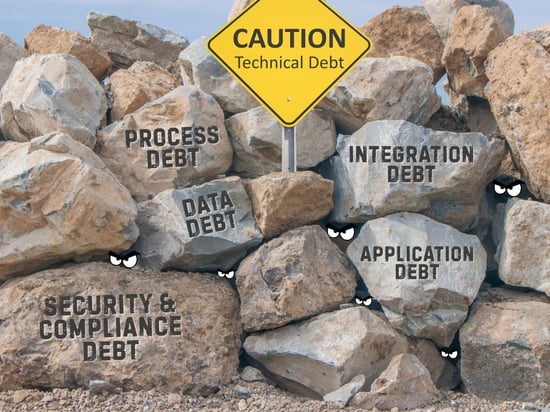
Individually, each type of debt may seem manageable. Collectively, they create an environment where change becomes slow, expensive, and unpredictable.
Technical Debt Has Become Intolerable for Manufacturers
Technical debt has always existed in manufacturing. What’s changed is that the side effects are now intolerable.
Modern manufacturing strategies increasingly depend on real-time visibility, rapid replanning, and tighter alignment between planning and execution. AI-enabled insights, scenario analysis, and advanced optimization promise value, but only when they’re fed by reliable, interoperable data and supported by execution systems with enough flexibility to respond. When technical debt accumulates, production planning becomes slower and less reliable, forcing planners and plants to operate from partial information and increasing reliance on buffers and manual intervention.
This shift has also created hesitation. “Wait and see” and “delay until it’s ready” are not uncommon as teams pause while AI disruption accelerates around them. Although thousands of innovative groups have conducted exploratory trials or proof-of-concept projects over the last 12-24 months, far less time has been spent consolidating lessons learned and translating them into repeatable best practices. As of year-end 2025, more than 187 AI governance requirements were under development, with more to come and at a pace that is unlikely to keep up with the evolution of AI itself.
In debt-heavy environments, the basic conditions modern manufacturing strategies depend on aren’t present. Discovery takes longer. Testing becomes fragile. Integrations delay rollout. Improvements that should take just hours, days, or weeks stretch into weeks and quarters. As a result, digital initiatives stall not because the tools are insufficient, but because the underlying environment cannot support change.
At the same time, organizations are becoming more aware of and much less tolerant about the cost of legacy complexity. Leadership teams now recognize that technical debt is not neutral; it actively wastes capacity, slows transformation, and compounds risk. The opportunity cost is significant: time and resources spent maintaining complexity is resources and time not investing in better performance.
This convergence—higher expectations for speed and intelligence plus greater transparency about the cost of complexity—is why technical debt has moved up the chain of command and become an urgent issue. Whether it exists is no longer the question, but how long an organization can afford to operate under its drag and how quickly it can get out from under it.
True Cost of Technical Debt in Manufacturing Is Hidden
Manufacturing companies often underestimate technical debt because its costs do not sit neatly in one place. Unlike a capital project with a defined budget, technical debt shows up every day and everywhere across the manufacturing value stream: hurting throughput, wasting or hiding capacity, excess inventories or shortages, distorting decisions, and eroding performance in hundreds of ways that are easy to normalize, hard to quantify, and even harder to spot.
In practice, having multiple systems does not mean having clarity. When System A and System B are digitally siloed, it becomes difficult to understand how their data relates—or how decisions in one area affect outcomes elsewhere.
The most visible impact is rarely the cost of digital projects. The largest cost is operational. In a debt-heavy environment, production schedules are slow to adjust, planners and plants operate with partial or conflicting information, and shop-floor decisions are made without full visibility about constraints, material availability, or downstream impact. The result is lost manufacturing capacity—not because demand is absent, but because the systems supporting execution can’t respond fast enough or reliably enough.
Technical debt also drives excess inventory. When people don’t have confidence in data and planning outputs, they compensate with buffers: more raw materials, more work-in-process (WIP), more finished goods. Inventory becomes insurance against uncertainty. That insurance ties up working capital, masks underlying issues, and drives up the cost of every unit produced.
Service performance suffers under technical debt too. Missed on-time delivery leads to expediting, premium freight, and last-minute schedule changes that further destabilize operations. Over time, these failures extend beyond cost. Customers lose confidence. Commitments become harder to make, and harder to keep. Reputation erodes quietly, long before it shows up in revenue forecasts.
There’s also a competitive dimension that is often hiding just below the surface. Manufacturers carrying significant technical debt are not standing still; they are falling behind. Competitors with cleaner architectures, better data flows, and tighter alignment between planning and execution respond faster to demand shifts, operate with leaner inventories, and absorb disruption with less friction. Over time, that responsiveness compounds into gains in market share, stronger customer relationships, and faster growth.
Yet, none of these impacts appear as a single line item. They show up in lost capacity, excess inventory, missed delivery, higher logistics costs, slower growth, and constrained strategic options. For executives, the takeaway is not simply that technical debt makes projects more expensive. It’s that technical debt quietly taxes day-to-day manufacturing performance and widens the gap between organizations that execute decisively and those that cannot.
Neglected, technical debt becomes a structural drag on operations, competitiveness, and growth—one that increases precisely when manufacturers are under the greatest pressure to move faster.
How Technical Debt Shows Up Across the Executive Team
One of the reasons technical debt persists in manufacturing is that it looks different depending on where you sit. Each executive role experiences the impact in a specific way, but the root cause is the same: fragmented systems, inconsistent data, and execution environments that can’t keep pace with the business. Even well-established manufacturing execution system software struggles to deliver value when it is surrounded by brittle integrations, inconsistent data, and disconnected planning systems.
Technical debt often fractures the executive view of performance. Different functions rely on different metrics and data sets, not because one group is right or wrong, but because no single, trusted view exists. There is often no real attempt to link metrics across organizational disciplines, and corporate goals and metrics don’t cascade neatly to departments. When data is inconsistent, everyone adapts—shaping reports to answer local questions and support local decisions. The result is not bad behavior, but fragmented truth: multiple views that make sense individually, yet fail to align into a clear picture of enterprise performance.
CIO / CDO: Strategy Bottlenecked by Reality
For CIOs and Chief Digital Officers, technical debt shows up as friction between strategy and execution. Initiatives around analytics, AI, advanced planning, or real-time visibility stall, not because the ideas are flawed, but because the underlying environment cannot reliably support them.
Expensive team members spend disproportionate time maintaining integrations, reconciling data, and managing exceptions instead of enabling new capabilities. Architecture decisions become defensive rather than strategic. Every new request raises the same concern: What will this break? Over time, the organization’s ability to modernize becomes constrained by the need to protect fragile dependencies.
The result is a growing gap between digital ambition and what can realistically be delivered.
COO / VP Operations: Performance Drag You Can’t Optimize Around
For operations leaders, technical debt shows up directly on the shop floor. Schedules are slow to adjust. Planners and plants operate on different versions of reality. Material availability, capacity constraints, and execution status are visible, but not always aligned.
In practice, technical debt weakens manufacturing operations management by breaking the link between planning decisions, shop-floor execution, and real-time feedback across plants.
When disruptions happen, response relies on manual coordination and workarounds rather than data-driven insight. Lost capacity becomes normalized. Firefighting replaces continuous improvement. Even strong operational teams struggle to sustain gains because the systems supporting execution do not reflect how the business actually runs.
From an operations perspective, technical debt isn’t abstract; it’s a persistent drag on throughput, service, and stability.
CSO / CEO / CFO: Margins, Reputation, and Growth at Risk
For senior business and finance leaders, technical debt shows up first in margins. When planning and execution are disconnected, teams compensate with inventory, expediting, overtime, and premium freight. Variability that could be managed upstream turns into downstream cost. Over time, these expenses become embedded in the operating model—treated as the cost of doing business rather than symptoms of systemic friction.
Reputation erodes alongside margins. Missed commitments, inconsistent service levels, and reactive execution weaken customer confidence even when short-term revenue holds. The organization becomes less predictable to work with and slower to respond, affecting renewals, contract negotiations, and long-term relationships.
Growth is constrained as a result. Expansion initiatives, new product introductions, and acquisitions take longer to integrate because the underlying environment cannot support change at speed. Investment risk increases, returns become harder to forecast, and competitors with better-aligned planning and execution widen the gap through more consistent performance.
For CSOs, CEOs, and CFOs, technical debt is not a future concern. It is a present constraint on margin protection, market confidence, and sustainable growth.
VP / Director of Operations & Manufacturing: Continuous Improvement That Doesn’t Stick
For manufacturing leaders and plant-focused roles, technical debt manifests as improvement that doesn’t hold. Initiatives deliver short-term gains, but performance slips once attention shifts. Root causes are hard to isolate because data is fragmented across systems and spreadsheets.
Standardization is difficult when each plant compensates for system gaps differently. Best practices don’t travel well. Visibility improves in some areas, but not end-to-end. Operations and the teams that support it work harder, but progress feels slower than it should be.
In this context, operational excellence becomes impossible to scale.
Performance Improvement / Operational Excellence Roles: Fighting the System Instead of Improving It
For continuous improvement and operational excellence teams, technical debt is the invisible constraint. Even when improvement opportunities are clear, implementation depends on manual processes or brittle integrations. Metrics lack consistency, and initiatives stall when they encounter system boundaries.
Instead of focusing on flow, variability, and performance, teams spend time reconciling data and negotiating process exceptions. The system becomes something to work around rather than a platform for sustained improvement.
While the symptoms show up differently by role, the underlying issue is shared. Fragmented systems and metrics prevent the organization from operating from a single, trusted view of performance—making sustained improvement harder to achieve, even when the right ideas are in place.
How Manufacturers Are Addressing Technical Debt
Leading manufacturers are no longer treating technical debt as a cleanup exercise or a prerequisite to future transformation. Instead, they’re addressing it as a core performance issue, one that directly affects how well the enterprise can plan, execute, and respond across sites.
The most effective companies start by focusing on the parts of the manufacturing value stream where debt creates the greatest drag: operational data that enables scheduling and execution alignment, material flow, inventory visibility, and response to disruption. Rather than attempting to fix everything at once, they prioritize data and insight constraints that limit throughput and service. This approach delivers visible operational improvement while quickly reducing risk.
These manufacturers are also shifting away from large-scale rip-and-replacement programs in favor of modular modernization. They preserve systems that are working, while improving how data and execution flow between planning, manufacturing, and supply chain. By strengthening interoperability instead of introducing more standalone tools, they reduce complexity and make change easier to absorb across diverse sites and operating models.
Another defining pattern is governance that enables progress rather than slowing it. Leading organizations establish clear architectural principles, shared data definitions, and execution standards that apply across plants, without forcing uniformity where it doesn’t fit. This balance allows local operations to remain flexible while ensuring enterprise-level alignment and visibility.
Finally, manufacturers addressing technical debt successfully treat modernization as an ongoing capability, not a one-time program. They measure progress in operational terms: schedule adherence, service levels, inventory performance, and time-to-value, rather than project milestones. Over time, this discipline compounds. Sites become easier to onboard, improvements travel faster, and the organization gains confidence in its ability to change without disruption.
For executive teams overseeing complex, multi-site manufacturing footprints, this shift is critical. Addressing technical debt is not just about modernizing systems: it restores responsiveness, protects margins, and enables sustained operational improvement across the enterprise.
Manufacturing leaders don’t need another transformation roadmap; they need to remove the constraints slowing execution. The most effective first step is a clear, objective assessment of where technical debt is limiting throughput, driving expediting, and inflating inventory across plants. That assessment must cut across planning, operations, data, and execution, not sit within a single function. From there, focus on fixing the disconnects that force teams to work around systems instead of with them, strengthening interoperability rather than replacing everything. Done with the right expertise and discipline, this approach delivers durable performance improvement at enterprise scale.

Topics discussed

Related Posts

Subscribe to Our Blog
Get the latest best practices and insights sent directly to you. (We promise, no automated marketing messages.)