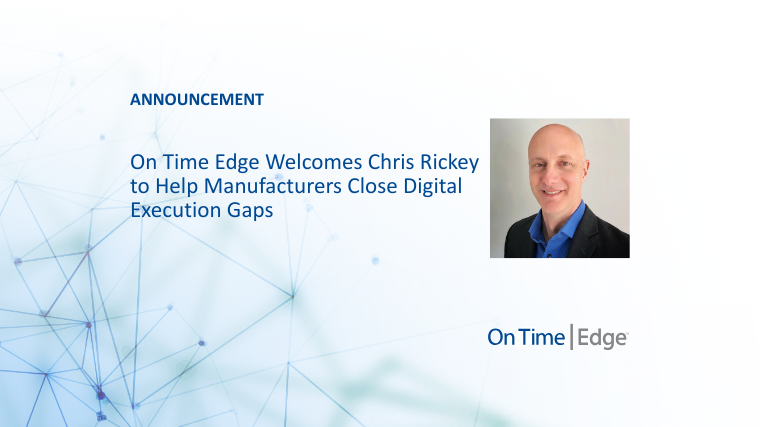
The appointment addresses persistent execution gaps that prevent digital manufacturing investments from delivering performance goals.
Denver, Colorado, January 27, 2026 – Manufacturers have invested heavily in MES and scheduling systems, yet many continue to fall short of manufacturing performance goals due to fragmented execution, misaligned architectures, and under-realized system value. In response to these persistent execution gaps, On Time Edge has hired Chris Rickey as a Global Manufacturing Principal Architect, strengthening its senior architecture bench to help manufacturers turn digital investments into coordinated, operationally effective systems. The move reflects growing pressure on operations, IT, and OT leaders to deliver measurable performance improvements from systems that too often fail to work together in practice.

Rickey brings more than two decades of experience working directly with manufacturers to assess where digital programs stall, why systems fail to work together, and how to realign technology with operational reality. His role focuses on helping operations, IT, and operational technology (OT) leaders translate digital ambition into strategies that they can then actually execute on the shop floor, throughout the plant network, and across the supply chain.
MES and Scheduling Investments Fall Short of Manufacturing Performance Goals
Manufacturers have invested heavily in MES, scheduling, and planning systems over the past decade. Yet many organizations continue to struggle with basic outcomes: reliable schedules, consistent execution, and timely, trustworthy data.
Common issues include:
- MES, scheduling, and planning systems deployed in isolation, without a unifying architectural view;
- Digital strategies defined at a conceptual level, but disconnected from how plants actually run;
- Accumulated technical debt that limits scalability and slows change; and
- Data fragmentation across IT and OT that undermines decision-making and responsiveness.
As a result, leaders are often accountable for throughput, quality, on time in full (OTIF), and on time delivery (OTD) targets without having systems that work together well enough to support those outcomes.
An Architecture-Led Approach to Manufacturing Digital Strategy
Rickey’s appointment reflects a shift away from technology-led digital roadmaps toward architecture-led digital strategies grounded in business outcomes and operational constraints. In this role, he will focus on identifying and correcting architectural misalignments that prevent MES, scheduling, and data systems from supporting consistent execution, performance recovery, and measurable manufacturing outcomes. His background spans MES, advanced production scheduling, and manufacturing data architecture—a combination that allows him to evaluate not just individual systems, but how execution, planning, and data foundations interact.
Rather than focusing on tool selection, his work centers on aligning digital investments to business objectives: understanding what manufacturers need to achieve operationally, where current systems and processes create friction, and what process and architectural changes are required to close the gap. This approach emphasizes outcomes over implementations and prioritizes strategies that can be executed incrementally without disrupting performance.
Rickey has held hands-on and leadership roles at Applied Materials, Rockwell Automation, Dassault Systèmes, and SymphonyAI. His experience spans high-tech, life sciences, electronics, solar, and battery manufacturing, operating at the intersection of operations, IT, and OT. Across these environments, he has worked directly with manufacturers facing complex, regulated, and high-throughput operations.
“Manufacturers aren’t short on systems—they’re short on strategies that account for how those systems actually behave together in the real world,” said Brian Vogel, CEO of On Time Edge. “Chris brings a rare ability to see across execution, scheduling, and data architecture at the same time. That perspective is essential right now as manufacturers face increasing pressure from AI-driven decision expectations, volatile capacity, and more fragile, interconnected supply chains—while still being held accountable for performance.”
What This Enables for Manufacturers
With Rickey in this role, manufacturers working with On Time Edge can expect:
- Clear assessments of how current MES and scheduling environments align to business outcomes;
- Digital strategies that connect execution, planning, and data rather than treating them as separate initiatives;
- Reduced risk of stalled transformations caused by misaligned systems or unrealistic roadmaps;
- A practical path to improving throughput, responsiveness, and scalability without starting over; and
- Stronger alignment between operations leadership, IT, and OT teams.
All trademarks, service marks, trade names, product names, and logos are the property of their respective owners.
###

Topics discussed

Related Posts
%20-%202x%20760x427.png?width=450&height=250&name=News%20Feature%20(1520%20x%20854%20px)%20-%202x%20760x427.png)

Subscribe to Our Blog
Get the latest best practices and insights sent directly to you. (We promise, no automated marketing messages.)