
Insights

Why Connected Factories Still Miss Performance Targets

From Hannover Messe 2026: Digital investments still aren’t delivering reliable performance.

an illustration of global connected factories

Insights from Hannover Messe 2026

Perspective

Everyone Was Talking About Data at Hannover Messe—But Almost No One Can Explain What It means for manufacturing.

by David Hinkler

Perspective

Manufacturers Say Measurable Outcomes Remain Elusive from Digital Investments—Despite Continued Spend.

by Diane Murray

Perspective

Manufacturing Stopped Selling Machines and Started Selling Data - First-hand recap of What David saw at Hannover Messe 2026.

by David Hinkler


Perspective

Manufacturing Execution Is Broken at Scale: What Hannover Messe 2026 Made Undeniable -The Problem Has Not Changed.

by Brian Vogel


Across Hannover Messe 2026, one pattern stood out: more connectivity, but not better performance.

Most manufacturers are more connected than ever—and still struggling to deliver consistent, measurable performance.

The issue isn’t a lack of systems, data, or investment. It’s that production plans aren't translating into executable, reliable schedules on the shop floor. When that happens, performance becomes unstable: constant replanning, missed commitments, and reduced responsiveness.

Book a 15-30 Minute Executive Diagnostic

Identify where your schedule breaks between planning and execution—and what it’s costing you.

Real-world results

A leading global pharmaceutical manufacturer shares how execution-aligned scheduling stabilizes performance.

Execution in practice

Hannover Messe 2026 stage session with a leading global pharmaceutical manufacturer

Outcomes

  • Reduced daily replanning — fewer disruptions and less reactive firefighting
  • Improved OTIF performance — more reliable delivery against commitments
  • Stabilized throughput — production flows became more predictable
  • Faster response to change — schedules could adjust in line with real-time conditions

The takeaway is straightforward: performance did not improve because more systems were added—it improved because scheduling became aligned with execution reality.

At Hannover Messe 2026, a leading global pharmaceutical manufacturer shared how persistent instability in planning and execution was impacting performance.

Despite significant investment in ERP, MES, and planning systems, schedules were not holding. Teams were forced into constant replanning, reacting to issues instead of executing with confidence. The underlying problem was not connectivity—it was that plans were not translating into executable, reliable schedules.

By shifting focus to execution-aligned scheduling—where real-world constraints, timing, and dependencies were reflected in the schedule—the organization was able to stabilize performance without replacing core systems.

Here's what you can achieve in 15-30 minutes with an executive diagnostic

an icon for broken production schedule

Identify where your production schedule breaks

Pinpoint where plans stop translating into executable schedules—whether in planning, scheduling, or shop floor execution.

an icon for the cost of unstable schedules

Quantify what it's costing you

Estimate the impact of unstable schedules on OTIF, throughput, and your ability to respond to disruption.

an icon for determine root cause

Understand the root cause

Determine whether the issue stems from data gaps, system architecture, or unclear decision ownership across planning and execution.

Where performance breaks down

Most manufacturers don’t have a planning problem. They have a translation problem.

Plans are created in ERP and planning systems with the assumption that they can be executed as-is. In reality, those plans must be interpreted, adjusted, and rebuilt into something the plant can actually run.

How it breaks

  • Planning systems generate an idealized plan based on demand, supply, and capacity assumptions
  • Schedulers manually translate that plan into a workable sequence—often using spreadsheets
  • Shop floor conditions immediately diverge (machine constraints, changeovers, delays, variability)
  • Replanning becomes constant, as teams try to keep up with reality instead of executing against a stable schedule

Implication

What looks like a connected, well-integrated environment on paper breaks down in practice.

Schedules become unstable, decisions slow down, and performance suffers—not because systems are missing, but because the link between planning and execution is unreliable.

The Execution Gap

On paper, the process looks connected. Plans flow from ERP into scheduling, and schedules are expected to drive execution on the shop floor. In practice, that connection breaks down. The schedule becomes the point where assumptions meet reality—and where those assumptions fail to hold.

What it looks like in practice

  • Plans that appear feasible cannot be executed as written
  • Schedules require constant adjustment to reflect real conditions
  • Decisions are made locally, without a consistent system of record
  • Execution drifts away from plan within hours—not days

This is the point where most digital strategies break down.


It’s the gap between what was planned and what can actually be executed.

This is the execution gap — where connected systems stop producing reliable outcomes.

Implication

Until this gap is addressed, more data, more systems, and more integration will not lead to better performance. They will only accelerate the cycle of replanning and instability.

Scheduling is the control layer

If plans aren’t translating into reliable outcomes, the issue isn’t planning—it’s control.

Production scheduling is where decisions become executable. It is the point where priorities, constraints, timing, and dependencies are turned into something the plant can actually run.

When scheduling is treated as a downstream task, disconnected from real-world conditions, performance becomes unstable. Plans may be sound, but execution will continue to drift.


Production scheduling is where decisions become executable.
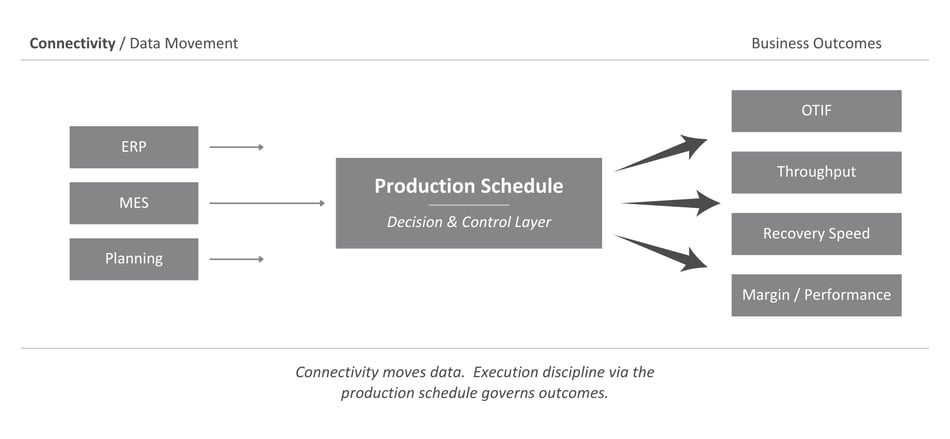
a diagram about how production schedule becomes the control layer

What changes when scheduling becomes the control layer

  • Decisions reflect real constraints — equipment, labor, materials, and changeovers are accounted for in the schedule
  • Schedules become executable — what is planned can actually be run on the shop floor
  • Change is absorbed, not disruptive — schedules adjust in line with real-time conditions
  • Execution stays aligned with intent — less drift between plan and reality

This is not about adding more systems or improving connectivity.

It's about making scheduling the point of control—where systems, data, and decisions come together to produce a stable, executable plan.

When scheduling functions as the control layer, performance improves not because the plan changed—but because the plan can finally be executed as intended.

Connectivity isn't the problem

At Hannover Messe 2026, one theme was consistent: more systems, more integrations, and more data. But despite that progress, measurable performance remains inconsistent. The issue isn’t whether systems are connected. It’s whether those connections enable decisions to be made and executed in real time.


What’s Missing in Practice

  • Data moves, but decisions lag — information is available, but not structured for action
  • Systems integrate, but don’t align — planning, scheduling, and execution operate on different assumptions
  • Visibility improves, but control does not — teams can see issues, but cannot respond fast enough
  • Architecture supports reporting, not execution — data is optimized for analysis, not real-time decision-making

Interoperability matters—but only if it supports execution.

Standards, platforms, and integration layers are valuable when they enable scheduling to function as the control layer—where data, constraints, and decisions come together in time to matter.

Without that alignment, connectivity increases complexity without improving outcomes.


More data and better integration will not fix unstable performance on their own.

Until systems, data, and decisions are aligned around executable scheduling, the gap between planning and execution will persist—regardless of how connected the environment becomes.

If this sounds familiar, it likely applies to you

a warning icon

You rely heavily on spreadsheets to manage scheduling

Critical decisions are made outside core systems to compensate for gaps.

a warning icon

You are constantly replanning

Schedules change daily—or multiple times per day—just to keep up with reality.

a warning icon

Your schedule takes hours (or days) to rebuild

By the time it’s ready, the situation has already changed.

a warning icon

Execution deviates quickly from plan

What looked feasible in the morning is no longer realistic by midday.

a warning icon

You can see issues, but can’t respond fast enough

Visibility has improved, but responsiveness has not.

a warning icon

No one clearly owns the schedule end-to-end

Planning, scheduling, and execution decisions are fragmented across teams, creating inconsistency and delays.

What to do next

If these patterns are familiar, the next step is not more analysis—it’s clarity.

You need to understand where your schedule breaks between planning and execution, and what is driving that breakdown in practice.

What the Diagnostic Will Show

  • Where the schedule loses integrity — the point where plans stop translating into executable work
  • What is driving instability — data gaps, architectural misalignment, or unclear decision ownership
  • How much performance is at risk — impact on OTIF, throughput, and responsiveness
  • What needs to change first — the highest-leverage move to stabilize execution

This is not a system evaluation or a software discussion.

It is a focused assessment of how decisions are made, translated, and executed in your environment—and why performance is not holding.

Schedule My Diagnostic

Identify where your schedule breaks—and what it’s costing you.