
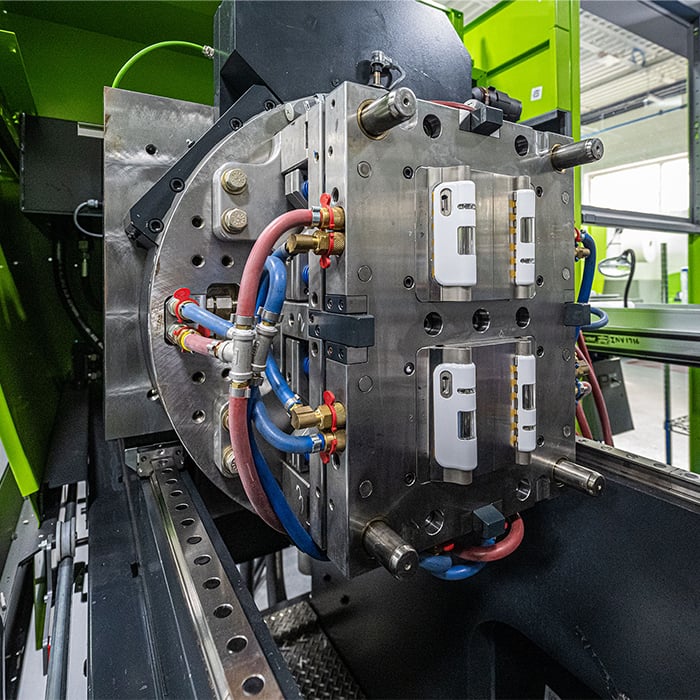


Vertically integrated medical device manufacturer serving leading OEMs across highly regulated markets.
This company is a premier global contract design and manufacturing organization (CDMO) dedicated exclusively to the medical technology industry. With more than 25 locations worldwide and a workforce of several thousand employees, the manufacturer partners with leading medical device OEMs to design, industrialize, and manufacture high-complexity Class II and Class III devices across orthopedics, surgical technologies, and drug delivery markets.
Operating in a life-critical, highly regulated environment, the company manages complex product portfolios, stringent quality requirements, long lead-time components, and variable demand profiles. Service performance, inventory discipline, and cash flow are not abstract metrics — they directly influence revenue realization, EBITDA, and the business’ ability to reinvest in innovation. In this environment, missed commitments are not planning errors; they are execution failures that erode trust internally and among customers
Five years after launching a major concurrent planning transformation built on Kinaxis Maestro, leadership faced a difficult reality: the projected $9.8M ROI tied to a $2.24M initiative had not materialized.
The Challenge: Planning Investment Fails to Translate into Reliable Execution
The company's original transformation initiative was designed around two primary value drivers:
- Revenue growth through restoring service levels above 95% OTD to Promise
- $5-6M in annual cash flow improvement through inventory optimization
The business case projected a 4.5:1 value-to-cost ratio with a three-month payback period. Nearly five years later, none of those objectives had been fully achieved. A new Vice President of Supply Chain inherited the program, along with rising executive scrutiny. The CFO needed clarity on whether additional investment was justified. Some leaders were openly questioning whether the original system decision had been correct. The initiative had quietly shifted from “transformation” to “potential failure.”
Operationally, the symptoms were tangible:
- Sites were not consistently meeting >95% OTD-to-promise targets
- Inventory reductions tied to $4M in cash flow had not materialized
- EBITDA improvements associated with planning were unrealized
The issue was not connectivity, and it was not the absence of planning tools. The issue was whether the organization could reliably translate plans into predictable production performance.
At the planning level, workarounds had crept in:
- Scenario simulations were slow and often easier to model in Excel.
- Capacity appeared feasible in aggregate but was not truly constrained at the resource level.
- Alternate routings introduced bias and distorted load balancing.
- Load visibility was bucketed at work order end-dates rather than viewed daily or by resource.
In practical terms, the planning layer was being pushed to perform detailed, finite scheduling functions it was not architected to handle. Leadership didn’t know whether the issue was:
- Tool limitation
- Configuration gaps
- Process breakdown
- Organizational misalignment
Before committing more capital, starting implementation from scratch, or changing vendors, the executive team needed an objective opinion.
The Turning Point: Demanding Clarity Before Committing More Capital
The decision to conduct a focused value assessment — rather than immediately re-implement or replace the system — was deliberate. The Vice President of Supply Chain required:
- A lower-risk diagnostic versus a full-scale restart
- An unbiased, defensible evaluation
- Immediate quick-win opportunities
- A clear go/no-go decision framework for the CFO
This was not theoretical research; it was an executive inflection point. The assessment was structured to provide concrete answers to specific questions:
- Is the Maestro implementation salvageable?
- Is the issue primarily processes?
- Is a structural finite scheduling layer required?
- Is the next step defensible to the board?
By framing the engagement around business value rather than system tuning, leadership shifted the conversation from “What’s wrong with the tool?” to “What decisioning framework delivers predictable production performance and required financial outcomes?”
The Solution: Creating Clarity and a Plan for Reliable Execution and Clear Governance with Disciplined Value Assessment
The engagement followed a disciplined two-month roadmap across three stages:
Stage One: Onboarding
- Align on original Maestro business goals
- Validate baseline KPIs
- Conduct cross-functional surveys
- Assess configuration across demand, inventory, supply, and capacity planning
The onboarding stage clarified the delta between intended design and actual operating reality.
Stage Two: Planning
- Conduct structured workshops
- Conduct deep-dive interviews with planners and stakeholders
- Align on opportunity-for-improvement
- Categorize elements for “quick wins” versus “structural redesign”
The team identified 82 (eighty-two) discrete solutions mapped directly to 9 (nine) major pain points. Of these line items:
- 37 could be implemented immediately by the company internally
- Many high-effort modifications would become unnecessary if architectural adjustments were made
During this portion of the engagement, central reframing emerged: the organization was attempting to use a concurrent planning system as a finite scheduling engine. While many pain points could technically be addressed within Maestro, doing so would require extensive customization and still would not fully resolve resource-level constraint fidelity.
Furthermore, if the company incorporated a dedicated finite scheduling layer, the required solutions would drop from 82 to 45, and high-impact modifications would fall to roughly one-fifth of the originally estimated enhancement scope.
This was not a vendor critique. It was clarity on what was required to make execution reliable.
Stage Three: Execute Framework
The assessment concluded with:
- Quick wins priorities
- One to three year strategic roadmap
- Use case valuation aligned to service, inventory, and EBITDA outcomes
More importantly, the plan embedded critical governance:
- Clear ownership for configuration changes
- Process alignment expectations
- Data accuracy mandates (BOMs, routings, lead times, safety stock logic tied to service levels)
The Results: A Defensible Path to Reliable Performance
The strongest immediate outcome was executive clarity and restored confidence in how production performance could be governed. Within weeks, the Vice President of Supply Chain was equipped with:
- A defensible assessment of why the original ROI expectations had not materialized
- Immediate internal actions (37 quick wins)
- A budget-informed, board-ready roadmap for the next 1-3 years
Rather than continuing incremental tuning efforts that might never close the performance gap, leadership now understood:
- Which issues were process-driven
- Which were configuration-driven
- Which were structural architecture gaps
“We needed clarity before committing another dollar. The value assessment gave us a fact-based view of what was salvageable, what was misaligned, and what required architectural change.”
Operationally, the quick-win portfolio focused on:
- Correcting over-committed capacity release policies
- Enforcing planning horizons for firm planned orders
- Cleaning alternate routing bias
- Improving resource-level constraint modeling
While full financial capture is still in progress, executive leadership is now positioned to directly correlate:
- Service-level recovery to accelerate revenue;
- Inventory discipline to free cash flow; and
- Capacity fidelity to protect EBITDA.
The organization moved from uncertainty and political tension to structured performance accountability around how production commitments are made and kept.
Organizational Impact: From Workarounds to Aligning People, Process, and Accountability Around Reliable Performance
Five years of underperformance had created quiet skepticism. Some executives had questioned the original implementation decision. Planners relied on spreadsheets and workarounds for agility. The value assessment reframed the discussion from blame to execution reliability.
It also revealed and reinforced the need for:
- ERP data accuracy (BOMs, routings, lead times)
- Safety stock tied to service-level logic
- Talent attraction and retention through best-in-class tools
While still too early to declare full business-value realization, leadership acknowledges a critical shift: The conversation is now about measurable outcomes and structural capability, not system frustration.
On the Horizon: Institutionalizing Predictable and Reliable Execution
The company’s path forward is measured and disciplined. The next phase focuses on:
- Executing the 37 internal quick wins;
- Establishing closed-loop decisioning around finite scheduling;
- Sequencing high-impact modifications based on financial correlation; and
- Building governance mechanisms to prevent regression.
Longer term, leadership intends to:
- Correlate schedule fidelity to accelerate revenue;
- Tie inventory turns directly to freeing up cash flow;
- Institutionalize planning standards across global sites; and
- Develop a center of excellence focused on sustaining supply chain outcomes.
The original business case projected a $9.8M ROI. The current objective is not to restate that promise, but to rebuild it on defensible operational footing. In a regulated medical device environment, service reliability and inventory discipline are not optional. They are structural. The value assessment did not promise transformation. It delivered clarity — and a path to reclaim the performance improvement outcomes leadership originally sought to achieve.